Penedès vs Priorat: Which Wine Day Trip from Barcelona?
Penedès DO and Priorat DOQ are both Catalan wine regions, both reachable from Barcelona, and very different drinks. A practical guide to picking the right day.
If you have one wine day from Barcelona, the choice is usually between Penedès — Catalonia’s white-wine and Cava heartland, an hour out — and Priorat, the rugged red-wine country on licorella-slate soil, a longer trip with a different character of wine at the end of it. They are both legitimate Catalan wine regions; they are completely different drinks. This guide explains which one fits which kind of traveller. The featured Penedès vineyards tour from Barcelona goes to the first; the second is a different day entirely.
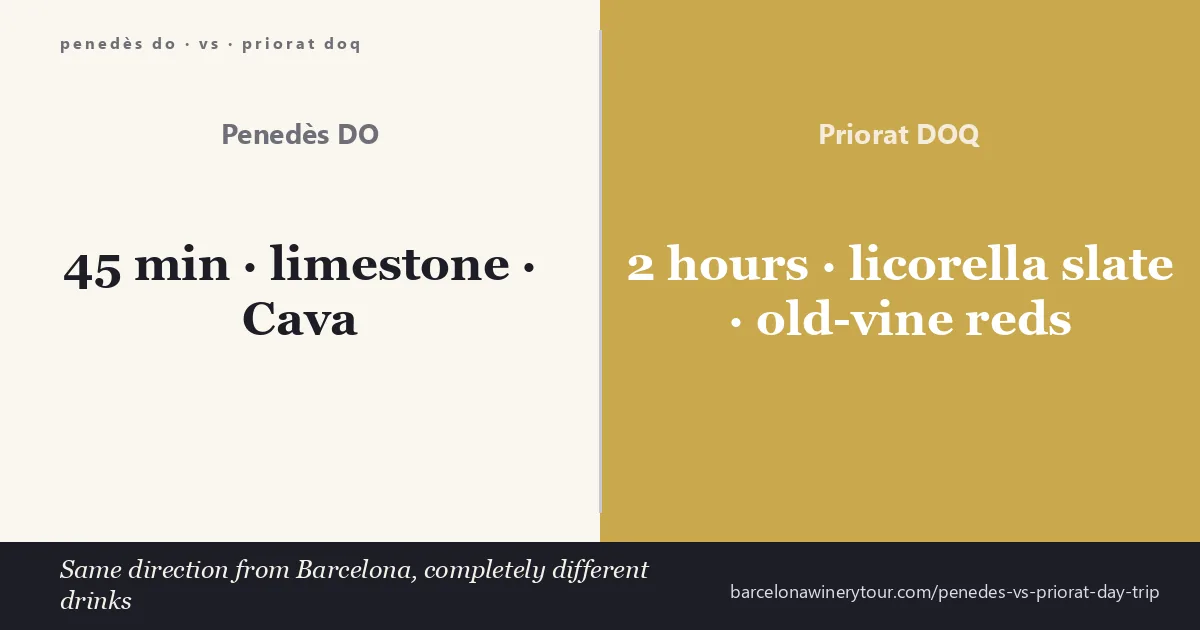
The Short Version
| Penedès DO | Priorat DOQ | |
|---|---|---|
| Direction from Barcelona | South-west | South-west |
| Distance | ≈46–52 km / 40–45 min via AP-7 | ≈130–160 km / ≈2 h |
| Comarca | Alt Penedès (Sant Sadurní d’Anoia) / Baix Penedès | Priorat (Tarragona province) |
| What it’s known for | Cava + white wine + growing red production | Powerful, mineral red wine |
| Signature soil | Limestone + calcareous | Licorella (slate) |
| Climate | Mediterranean, milder | Continental, more extreme, steep terraces |
| Signature grapes | Macabeo, Xarel·lo, Parellada (whites for Cava) | Garnatxa Negra, Carinyena (reds) |
| DO/DOQ status | DO (regional council 1960) | DOQ (Catalan gov 2000; national confirmation 2009) |
| Typical bottle price (entry) | €8–€20 | €20–€60 |
| Day-trip feasibility | Easy half- or full-day | Full day; overnight is comfortable |
Both are reachable in a day from Barcelona. Only one is comfortable as a half-day.
Penedès DO: Catalonia’s Cava Heartland
The Penedès sits south-west of Barcelona, between the coast and the inland hills, on limestone soil with a Mediterranean climate. The administrative comarca of the region’s most famous town — Sant Sadurní d’Anoia — is Alt Penedès, the wine zone extending into Baix Penedès and parts of neighbouring comarques.
The region is best known for sparkling wine. Sant Sadurní d’Anoia produces around 95% of all Cava — together with its surrounding Penedès towns — and the cellars built around the town form one of the densest concentrations of traditional-method sparkling-wine production in Europe. To see how these towns and wineries sit relative to Barcelona, browse our interactive Penedès wine-region map, which plots the cava heartland, Vilafranca and the day-tour vineyards side by side.
What you can taste in Penedès:
- Cava — the entire DO from entry-level Cava de Guarda through Cava de Paraje Calificado, the single-vineyard top tier
- Still whites — increasingly serious wines from Xarel·lo (the most distinctive native grape, with herbal-almond character and ageing potential), Macabeo, Parellada, plus Chardonnay
- Growing red production — Tempranillo (locally called Ull de Llebre), Garnatxa, Cabernet Sauvignon, and especially well-regarded Pinot Noir for serious estates
Distinct producers you can visit:
| Producer | Town | Tour price (2026) | Why visit |
|---|---|---|---|
| Codorníu | Sant Sadurní d’Anoia | €25–€30 (Heritage / Iconic with train) | The original commercial Cava house (1872); Modernist architecture by Josep Puig i Cadafalch, declared a Historic-Artistic Monument in 1976; 30 km of underground galleries on 5 levels |
| Freixenet | Sant Sadurní d’Anoia | €21.50 | Founded 1914 by Pedro Ferrer Bosch + Dolors Sala Vivé; the export-market giant; full Cordon Negro tour |
| Familia Torres | Pacs del Penedès | €26 (Waltraud Cellar) | One of Catalonia’s most respected wine families; serious still wines as well as Cava-style sparkling |
| Recaredo | Sant Sadurní d’Anoia | €42 (Origen Tour) | Boutique Cava specialist; consistently among the most awarded |
| Llopart | Subirats | €28–€33 (Panoramic / Integral) | Family estate with sweeping views over the Penedès |
(Prices verified June 2026; check producer sites at booking.)
Priorat DOQ: The Red-Wine Pilgrimage
Priorat sits roughly two hours south-west of Barcelona in the Tarragona province — significantly farther than the Penedès. The wine here is in a completely different category: dense, mineral, structured reds that have been the engine of one of the most striking quality revivals in modern European wine.
The defining feature is licorella — a black, glossy, slate-and-quartzite soil that the vines have to push their roots through to find water and nutrients. The result is low yields, concentrated grapes, and wines with a recognisable mineral signature. The terrain is steep enough that vineyards are terraced; harvest is largely manual; mechanisation is limited by geology.
What you can taste in Priorat:
- Garnatxa Negra (Garnacha) and Carinyena (Carignan) — the two traditional Priorat reds, often old-vine, often blended; this is the heart of the region
- International blends — Cabernet Sauvignon, Syrah, and Merlot are widely planted in newer estates; produce powerful Priorat-style wines with international varietal character
- White Priorat — small production but rising; usually built around Garnatxa Blanca
The classic Priorat wine is concentrated, dark, mineral, and built to age — a recognisable style that put the region on the world wine map in the 1980s and 90s.
Status: Priorat is one of only two Spanish wine regions to hold the top-tier Denominació d’Origen Qualificada status (Catalan); the equivalent Castilian term is Denominación de Origen Calificada (DOCa). The other is Rioja, which earned the status in 1991. Priorat was promoted by the Catalan government in 2000, with national confirmation in 2009 — the second region in Spain to hold the highest legal wine tier.
The Five “Clos” Pioneers and the Modern Revival
Priorat’s modern revival has a specific origin: a small group of Catalan and Catalan-adopted winemakers who arrived in the region in the late 1970s and 1980s when the vineyards were largely abandoned. René Barbier arrived first, in 1979, drawn by the licorella slate and the old Garnatxa vines; he was joined through the 1980s by Álvaro Palacios, Daphne Glorian (Clos Erasmus), José Luis Pérez, and Carles Pastrana. The five founders pooled their resources to produce a single historic shared 1989 vintage — the moment usually cited as the start of modern Priorat.
Their estates today are among the most respected names in Spanish wine — Barbier’s Clos Mogador, Palacios’ L’Ermita, Glorian’s Clos Erasmus, Pérez’ Clos Martinet, and Pastrana’s Clos de l’Obac. The “Clos” naming convention they adopted is a signature of the era.
In 2019, the DOQ formalised a four-tier “Els Noms de la Terra” terroir classification — Vi de Vila (village wine, introduced earlier in 2009), Vi de Paratge (specific place), Vinya Classificada (classified vineyard), and Gran Vinya Classificada (grand classified vineyard). The system mirrors Burgundy’s village / premier cru / grand cru hierarchy and is one of the most rigorous vineyard-quality classifications in Spain.
The Carthusian Monastery That Gave the Region Its Name
The literal origin of “Priorat” is the Cartoixa d’Escaladei — a Carthusian monastery founded in 1194 in the foothills of the Montsant mountain range. The monastery’s prior historically ruled the surrounding seven villages, and the territory under his ecclesiastical jurisdiction came to be called the Priorat (priorate). The monks planted the first vines on the licorella slate, and many of today’s vineyards trace their land directly to the monastery’s medieval holdings. The ruins of Escaladei sit at the head of the valley and are a worthwhile stop on any Priorat day; the village of La Morera de Montsant sits a short drive away.
Falset: The Capital and the Tour Base
Falset is the comarca capital and the practical base for Priorat-focused tours. It hosts the Castell del Vi — the Priorat Wine Museum, housed inside the medieval Castell de Falset — and the Cooperativa Falset Marçà, an architecturally remarkable modernist co-op winery built in 1919 that still operates and pours for visitors. Multiple tasting venues, restaurants, and small hotels make Falset the natural overnight stop for a two-day Priorat trip.
Garnatxa: A Catalan Story That Started in Aragón
A note about the grape: Garnatxa Negra (called Garnacha in Castilian, Grenache in French, Cannonau in Sardinian) is one of the most widely planted red grapes in the world, and it has a Spanish-Catalan story. The grape originated in Aragón, then spread to Catalonia, French Roussillon, and Sardinia largely through the medieval Crown of Aragon — the political union that linked Catalonia, Aragón, Valencia, and the Balearic Islands. Priorat is one of the great Garnatxa heartlands in the world; the old-vine plantings on licorella slate are now among the most sought-after in modern Spanish wine.
Day Trip Logistics Compared
Both regions are reachable from Barcelona, but the day looks very different.
Penedès day trip
- Drive time: 40–45 minutes each way via AP-7
- Typical tour structure: Morning pickup → visit 1 or 2 wineries (45–90 min each) → tasting and food at one of them → return mid- to late afternoon
- Featured option: The Penedès 4WD vineyards tour — central-Barcelona pickup, two family wineries (Pere Ventura Cava and Can Bas), tastings of three still wines and four Cavas paired with local cheese and charcuterie, 4WD ride through the vineyards, 10th-century estate chapel stop, $144 with free cancellation up to 24 hours
- Public transport: RENFE train Barcelona-Sants → Sant Sadurní d’Anoia in around 50 minutes; some wineries are walkable from the station, others need a short taxi
- Self-drive: Easy parking, mostly flat AP-7 motorway, but Spanish drink-driving law in 2026 is 0.2 g/L blood alcohol for all drivers — effectively any tasting means a designated driver
Priorat day trip
- Drive time: Around 2 hours each way; the last stretch is on winding rural roads
- Typical tour structure: Early pickup (around 8 am) → drive → 1 or 2 winery visits → lunch in a Priorat village (often included) → drive back; full day, 10–12 hours door-to-door
- Why an overnight is better: The drive eats four hours of your day. Many travellers stay one night in a Priorat village (Gratallops, Falset, Porrera, Torroja) and spend two days visiting cellars, walking among the terraced vines, and eating in the local restaurants
- Public transport: Awkward; the region is rural, with limited bus connections; guided tours or self-drive are the realistic options
- Tour cost: Priorat full-day tours from Barcelona typically run higher than Penedès equivalents because of the longer transport leg
How to Pick
| You should choose Penedès if you… | You should choose Priorat if you… |
|---|---|
| Have a half-day or short-window slot | Have a full day or an overnight in your trip |
| Love Cava and traditional-method sparkling wine | Love powerful, mineral red wine |
| Want to compare 3+ wines at moderate prices | Want to taste age-worthy, premium-tier reds |
| Are first-time visitors to Catalan wine country | Have already done Penedès and want the next step |
| Are travelling with non-drinkers who want food and scenery | Are wine enthusiasts focused on a specific style |
| Want easy public-transport access (RENFE direct) | Have a rental car or are willing to commit to a full-day guided tour |
The honest case is that most first-time visitors to Catalan wine country should do Penedès. The region is closer, more diverse (whites + reds + Cava), better-equipped for day-trippers, and the introduction it provides to the méthode traditionnelle in its commercial birthplace is unique. Priorat is the connoisseur’s second visit — the depth of Catalan wine — and it rewards the extra time you give it.
What About Montsant?
A footnote worth knowing: Montsant DO is a 2001-created appellation that physically rings Priorat — a “doughnut” of land surrounding the DOQ, planted with similar varieties (Garnatxa, Carinyena) on different soils (more limestone and clay). The wines are often excellent, frequently come from the same families that own Priorat estates, and reliably cost less. If a Priorat tour offers a comparative tasting with Montsant, take it — the difference between licorella-slate and limestone-clay vineyards is one of the clearest soil-driven flavour lessons in Spanish wine.
Ready to Book?
The Penedès is the easier introduction to Catalan wine country, and the featured Penedès 4WD vineyards tour from Barcelona is built around exactly that brief: a small group, central-Barcelona pickup, two family wineries, a 4WD ride through the vines no minibus can reach, three still wines plus four Cavas, local cheese and charcuterie. $144 per person, free cancellation up to 24 hours, 4.8/5 from 847+ guests. See also our Cava vs Champagne buyer’s guide for the bottle side of the story, and the Catalan DO/DOQ system explained for the full regional map.
Penedès Vineyards Tour from Barcelona — Wine, Cava & 4WD
Join 847+ guests who rated this experience 4.84/5. Pickup in central Barcelona, 4WD through Catalan DO vineyards, two family wineries, seven wines and Cavas, a 10th-century chapel, and local cheese and charcuterie. Free cancellation up to 24 hours.
Check Availability & Book