Cava vs Champagne: A Buyer's Guide
Cava DO and Champagne AOC — same méthode traditionnelle, different geography, grapes, and price. A respectful guide to when each is the right bottle.
If you book the Penedès vineyards tour from Barcelona, you will taste both still wine and Cava in the cellars where the latter was first made commercially. Cava and Champagne are often presented as rivals, and the framing is usually wrong: they are two distinct appellations — Cava DO in Catalonia, Champagne AOC in France — that share the same production method, the méthode traditionnelle, and each have their own legal protection, regional identity, and reasons to exist. This guide explains the difference on its own terms.
The Short Version
| Category | Cava DO | Champagne AOC |
|---|---|---|
| Country | Spain (≈95% Catalonia) | France |
| Heart of production | Sant Sadurní d’Anoia, Penedès | Reims, Épernay, Marne Valley |
| Created | 1986 (Royal Decree, 27 February) | 1936 (one of the first AOCs) |
| First commercial bottle | Codorníu, 1872 (Josep Raventós i Fatjó) | Various Maisons, 17th-19th c. |
| Method | Méthode traditionnelle (2nd fermentation in bottle) | Méthode traditionnelle (2nd fermentation in bottle) |
| Primary white grapes | Xarel·lo, Macabeo, Parellada | Chardonnay |
| Primary red/black grapes | Garnatxa, Trepat, Monastrell, Pinot Noir (rosé) | Pinot Noir, Pinot Meunier |
| Minimum aging on lees | 9 months (Cava de Guarda) | 12 months (non-vintage) |
| Top tier aging | 36 months (Cava de Paraje Calificado) | 36 months (Vintage) |
| Typical price band | Mid-tier | Premium |
Both are made the slow expensive way. The price difference comes from geography, branding, and the cost structure of the Champagne region — not from the work in the cellar.
Same Method: How Both Wines Are Actually Made
The méthode traditionnelle — also called the méthode champenoise when the bottle is from Champagne — is identical across Cava and Champagne. The same eight steps in the same order:
- Base wine — primary fermentation in tank, the way still wine is made
- Assemblage — blending of base wines from different grapes, plots, or vintages
- Tirage — bottling with added yeast and sugar to trigger a second fermentation
- Second fermentation in the bottle — yeast eats the sugar; CO₂ has nowhere to go; bubbles form
- Aging on the lees — bottles rest horizontally on dead yeast cells, developing the toasty, biscuit notes
- Riddling (remuage) — bottles are slowly rotated and tilted neck-down so the sediment collects against the cap
- Dégorgement — the neck is frozen, the cap removed, the yeast plug pops out under pressure
- Dosage — a wine-and-sugar top-up sets the final sweetness, and the bottle is corked
This is the same process used by Crémant producers in eight French AOCs outside Champagne (Alsace, Bourgogne, Loire, Limoux, Bordeaux, Jura, Savoie, Die), by Franciacorta DOCG in Italy’s Lombardy region (around 19 million bottles a year, stabilised), by Trento DOC (Italy’s first traditional-method DOC), by Sussex sparkling-wine producers in England (the UK’s first post-Brexit wine PDO, granted 5 July 2022), and historically by the monks of Saint-Hilaire in Limoux who recorded sparkling-wine production in 1531 — about 150 years before Dom Pérignon’s tenure in Champagne. The méthode traditionnelle is therefore a category practised across half a dozen European protected appellations; the appellations differ on geography, grape, and aging rules, not on the method itself.
What changes between Cava and Champagne is what you put through those eight steps: which grapes, grown on what soil, in what climate, by which winemaking tradition.
Different Grapes, Different Climate
Cava is built around three native Catalan grape varieties:
- Macabeo (Viura in Rioja) — fresh, apple-and-citrus base, makes up the largest share of the blend
- Xarel·lo — the structural backbone, gives Cava its slightly herbal, almond character and ageing potential
- Parellada — the elegance grape, contributes floral aromatics and acid
Chardonnay and Pinot Noir are also fully permitted in Cava DO, and modern producers use them. The four authorised red varieties for rosé Cava and for the blend are Garnatxa Tinta (Garnacha), Trepat (a native Conca de Barberà grape), Monastrell, and Pinot Noir — all four can appear on a Cava label.
Champagne is built around three different varieties:
- Chardonnay — the white, citrus and chalk-driven, behind Blanc de Blancs
- Pinot Noir — red-skinned, white juice, structure and aging potential, behind Blanc de Noirs
- Pinot Meunier — softer Pinot variant, fruit-forward, traditionally used in the blend
The grapes are different because the climates are different. The Champagne region is one of the northernmost wine regions in the world, growing on chalk subsoil at a latitude where ripening is marginal — which is exactly what gives Champagne its sharp acidity. The Penedès sits roughly 700 km further south on limestone soil with a Mediterranean climate; the grapes ripen reliably and the wines come in fruitier, slightly fuller, with a different aromatic profile.
Neither climate is better; they produce different drinks.
Aging Rules Compared
Aging on the lees — the time the bottle spends resting on the dead yeast — is what builds the toasty, brioche character of any traditional-method sparkling wine. Both Cava DO and Champagne AOC have legally defined minimums.
| Tier | Cava DO | Champagne AOC |
|---|---|---|
| Entry / non-vintage | Cava de Guarda — 9 months on lees | Non-vintage — 12 months on lees / 15 months total |
| Reserva tier | Cava de Guarda Superior Reserva — 18 months (raised from 15 in the 2021 reform) | Premium NV cuvées — often 24-36 months voluntarily |
| Gran Reserva | Gran Reserva — 30 months, vintage-dated only | (no equivalent legal tier) |
| Top single-vineyard | Cava de Paraje Calificado — 36 months, hand-harvest, max 8,000 kg/ha, 100% organic from 2025 harvest | Vintage Champagne — 36 months on lees minimum |
The Cava de Paraje Calificado tier was created in 2017 by Spanish-Ministry-of-Agriculture decree as the DO’s most stringent designation — a single-vineyard, vintage-dated, minimum-36-month-on-lees Cava with hand harvest, a yield cap of 8,000 kg/ha, and (from the 2025 harvest forward) 100% organic certification. As of mid-2026 there are exactly 15 wines holding the distinction, with five new additions made in March 2026. Among them are Pere Ventura Gran Vintage (one of the wineries the featured tour visits), Juvé & Camps La Capella, Codorníu Ars Collecta La Fideuera, Alta Alella Mirgin Exeo, Vins El Cep Claror, and Carles Andreu L’Era del Celdoni. The Reserva minimum was raised from 15 to 18 months in the 2021 reform of the DO regulations, which came into force on 1 January 2022.
A 2025 milestone worth knowing: Cava DO formalised the Cava Guarda Superior umbrella category covering Reserva, Gran Reserva, and Cava de Paraje Calificado — and from the 2025 harvest these tiers must all be 100% organic. “Guarda Superior” therefore does not replace the entry “Cava de Guarda” tier; it sits above it as the protected umbrella for the long-aged, organic-mandated Cavas.
For comparison, a non-vintage Champagne must spend at least 12 months on the lees and 15 months total bottling-to-release; a vintage Champagne, at least 36 months on the lees. Many Champagne Maisons voluntarily age longer — three-to-five years on lees for premium NV cuvées is common — which is one reason their wines cost what they cost.
The Sweetness Spectrum (Identical Across Both)
The EU dosage tiers apply identically to Cava DO, Champagne AOC, Crémant, and Sussex PDO — the same grams-of-residual-sugar-per-litre bands carry the same names in each language:
| Catalan / Spanish | French | g/L residual sugar |
|---|---|---|
| Brut Nature | Brut Nature / Pas Dosé | Less than 3 |
| Extra Brut | Extra Brut | 0–6 |
| Brut | Brut | Less than 12 |
| Extra Seco | Extra Sec / Extra Dry | 12–17 |
| Seco | Sec / Dry | 17–32 |
| Semi-Seco | Demi-Sec | 32–50 |
| Dulce | Doux | More than 50 |
“Brut” on a Cava bottle means the same as “Brut” on a Champagne bottle. The driest style most casual drinkers will reliably enjoy is Brut. “Extra Dry” — found mostly on Prosecco — is sweeter than Brut, an evergreen source of confusion.
Price: Where the Real Difference Sits
Cava typically lands at roughly half the price of comparable Champagne in restaurants and retail. The reasons are structural, not qualitative:
- Land cost. A hectare of vineyard in Champagne can trade for over €1 million; Penedès land is a fraction of that
- Brand premium. Champagne is one of the strongest agricultural brands in the world; that pricing power is real and earned
- Climate margin. Champagne’s northern climate means lower yields per hectare; the maths force higher prices
- Aging on lees. Champagne Maisons typically age longer than the legal minimum, which is genuine extra cost
- Maison vs estate. Most Champagne is sold by large Maisons with significant marketing and overhead; much of Cava is sold by family estates with leaner overhead
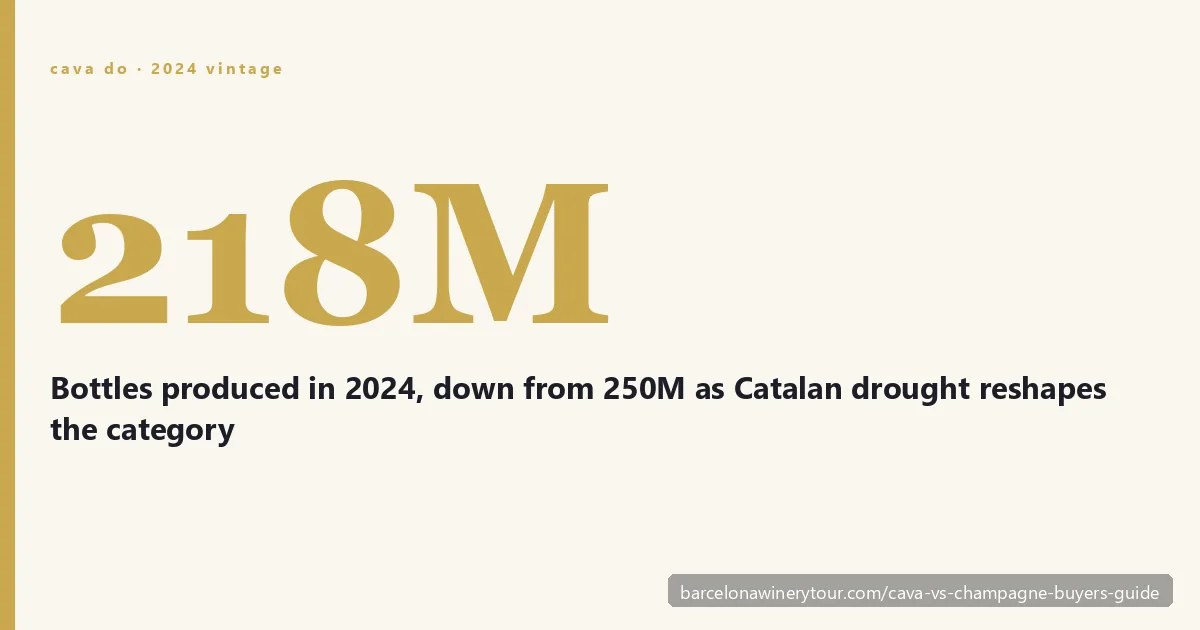
The 2024 vintage has added a new variable: severe drought in Catalonia cut Cava DO production to about 218 million bottles, down from roughly 250 million in 2023, and 2025 production fell further to around 190 million. Constrained supply tends to lift prices for higher tiers; entry-level Cava remains the value play.
When to Choose Each — Practical Cases
| If you want… | Choose | Why |
|---|---|---|
| Best-value sparkling at €10–€20 | Cava de Guarda or Reserva | Méthode traditionnelle character at supermarket price |
| A serious, age-worthy bottle for €40–€60 | Cava Gran Reserva or Paraje Calificado | Hand-harvest, 30+ months on lees, single-vineyard tier — its own distinguished category |
| A celebratory bottle with full Champagne pedigree at €60+ | Vintage Champagne | The Maison story, the chalk-cellar provenance, the longer aging |
| A wine that pairs with Iberian charcuterie and seafood | Cava Brut Nature | Matches Catalan and Spanish tapas tradition; built for that table |
| A wine that pairs with classic French cuisine and aperitif rituals | Champagne Brut | The drink and the cuisine grew up together |
| The driest possible style | Brut Nature in either category | Same sub-3 g/L band; no added sugar |
The right answer is rarely one or the other; it is matching the bottle to the occasion and the food. On a Penedès vineyards day from Barcelona you taste both still wines and four Cavas in the cellar where the method was first commercialised in 1872 — the best way to calibrate your own preferences.
Common Misconceptions Worth Correcting
- “Cava is the Spanish version of Champagne.” Cava is its own appellation with its own legal framework, its own grape varieties, and its own history. The two appellations share a method, not an identity.
- “Champagne is older.” The méthode traditionnelle was being practised in Limoux in 1531, roughly 150 years before Dom Pérignon. Cava as a commercial product began in 1872, Champagne AOC was formally codified in 1936 — neither tradition is “the original.”
- “Cava is always cheaper because it’s lower quality.” Cava de Paraje Calificado is single-vineyard, hand-harvested, 36-month-on-lees, vintage-dated, and 100% organic from 2025 — those are the same quality markers used for top-tier Champagne. The price difference reflects land cost, climate margin, and brand premium, not craft.
- “You can’t tell Cava and Champagne apart blind.” Trained tasters reliably can — the grape varieties give different aromatic signatures (Macabeo’s apple and Xarel·lo’s herbal-almond vs Chardonnay’s citrus and chalk).
Ready to Book?
The best way to understand Cava DO is to taste it where it is made — in the family cellars of the Penedès, paired with Catalan cheese and charcuterie, with a winemaker explaining the méthode traditionnelle in front of the bottles ageing under the limestone. The featured Penedès 4WD vineyards tour from Barcelona does exactly this for $144: central-Barcelona pickup, two family wineries, three still wines plus four Cavas, a 10th-century estate chapel stop, free cancellation up to 24 hours. See also our Penedès vs Priorat day-trip guide and the Catalan DO/DOQ system explained for the full regional picture.
Penedès Vineyards Tour from Barcelona — Wine, Cava & 4WD
Join 847+ guests who rated this experience 4.84/5. Pickup in central Barcelona, 4WD through Catalan DO vineyards, two family wineries, seven wines and Cavas, a 10th-century chapel, and local cheese and charcuterie. Free cancellation up to 24 hours.
Check Availability & Book