The Catalan DO and DOQ Wine System Explained
Every Catalan wine appellation in one place — Penedès, Priorat DOQ, Montsant, Cava DO and the rest, plus how DOQ/DOCa works in the Spanish system.
Walk into any cellar on the Penedès vineyards tour from Barcelona and the labels in front of you will tell you everything about how Spanish wine law works — DO, DOQ, Reserva, Gran Reserva, Cava de Paraje Calificado. The system is built up of nested appellations, and Catalonia uses it more intensively than any other Spanish region: eleven regional DOs and DOQ, the supra-regional Cava DO, and a comprehensive aging-tier framework. This guide explains the whole map.
The Spanish Wine Hierarchy in 30 Seconds
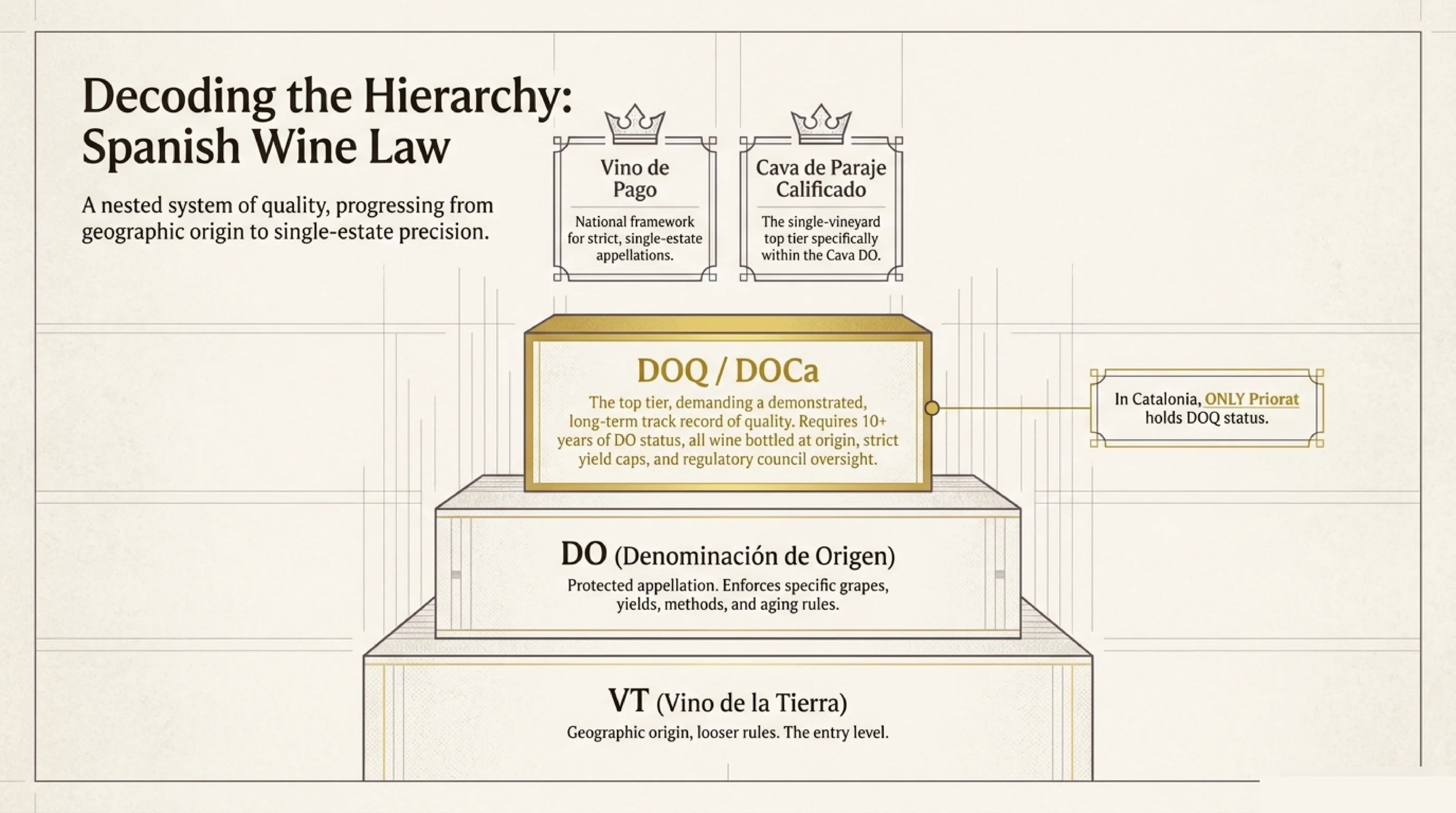
Spanish wine law builds upward through five named tiers:
| Tier | Catalan / Spanish | What it means |
|---|---|---|
| VT | Vino de la Tierra | Geographic origin, looser rules — entry level |
| DO | Denominació d’Origen / Denominación de Origen | Protected appellation; specific grapes, yields, methods, aging rules |
| DOQ / DOCa | Denominació d’Origen Qualificada / Denominación de Origen Calificada | The top tier; reserved for DOs with a demonstrated long quality track record |
| Vino de Pago | Vino de Pago | Single-estate appellation with its own strict rules; rare |
| Cava de Paraje Calificado | Cava de Paraje Calificado | The single-vineyard, top-tier subset specifically within Cava DO |
The first thing to know: DOQ and DOCa are the same legal status, written in Catalan and Castilian respectively. The Catalan government uses DOQ (“Qualificada”); the national Spanish framework uses DOCa (“Calificada”). They mean the highest legal tier in Spanish wine.
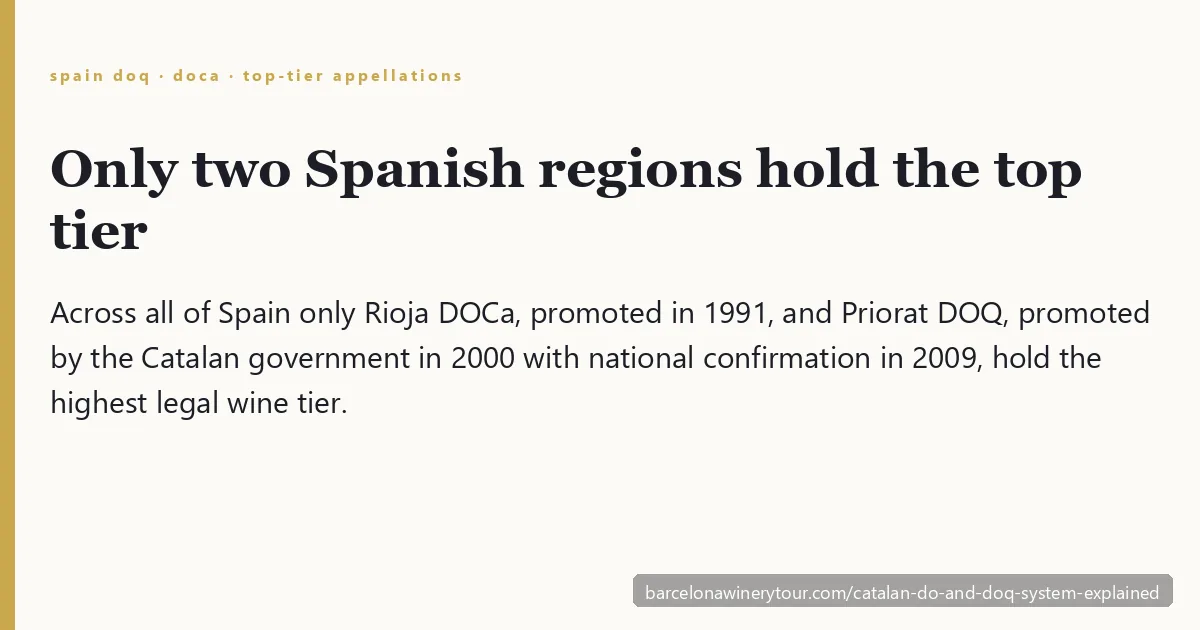
Across all of Spain, only two regions currently hold this status:
- Rioja DOCa — promoted in 1991 (and Spain’s oldest DO, recognised in 1925)
- Priorat DOQ — promoted by the Catalan government in 2000, with national confirmation in 2009
That’s it. Every other Spanish wine region you have heard of — Ribera del Duero, Rías Baixas, Penedès, Toro, Jumilla — sits at DO level.
INCAVI: The Catalan Regulator
A practical note for understanding Catalan wine labels: the Institut Català de la Vinya i el Vi (INCAVI) is the regional regulator that sits under the Catalan Wine Law 2/2020. It manages the DO specifications for Catalan regional DOs, runs the Horitzó 2028 strategic plan for the Catalan wine sector, and coordinates with Spain’s national agricultural ministry (MAPA) for EU compliance. Cava DO, because it spans multiple Spanish autonomous communities, sits under its own Consejo Regulador (the DO Cava regulatory council) rather than INCAVI alone — a useful distinction when reading the small print on a Cava bottle versus a Penedès still-wine bottle.
The Three Top-Tier Single-Vineyard Categories
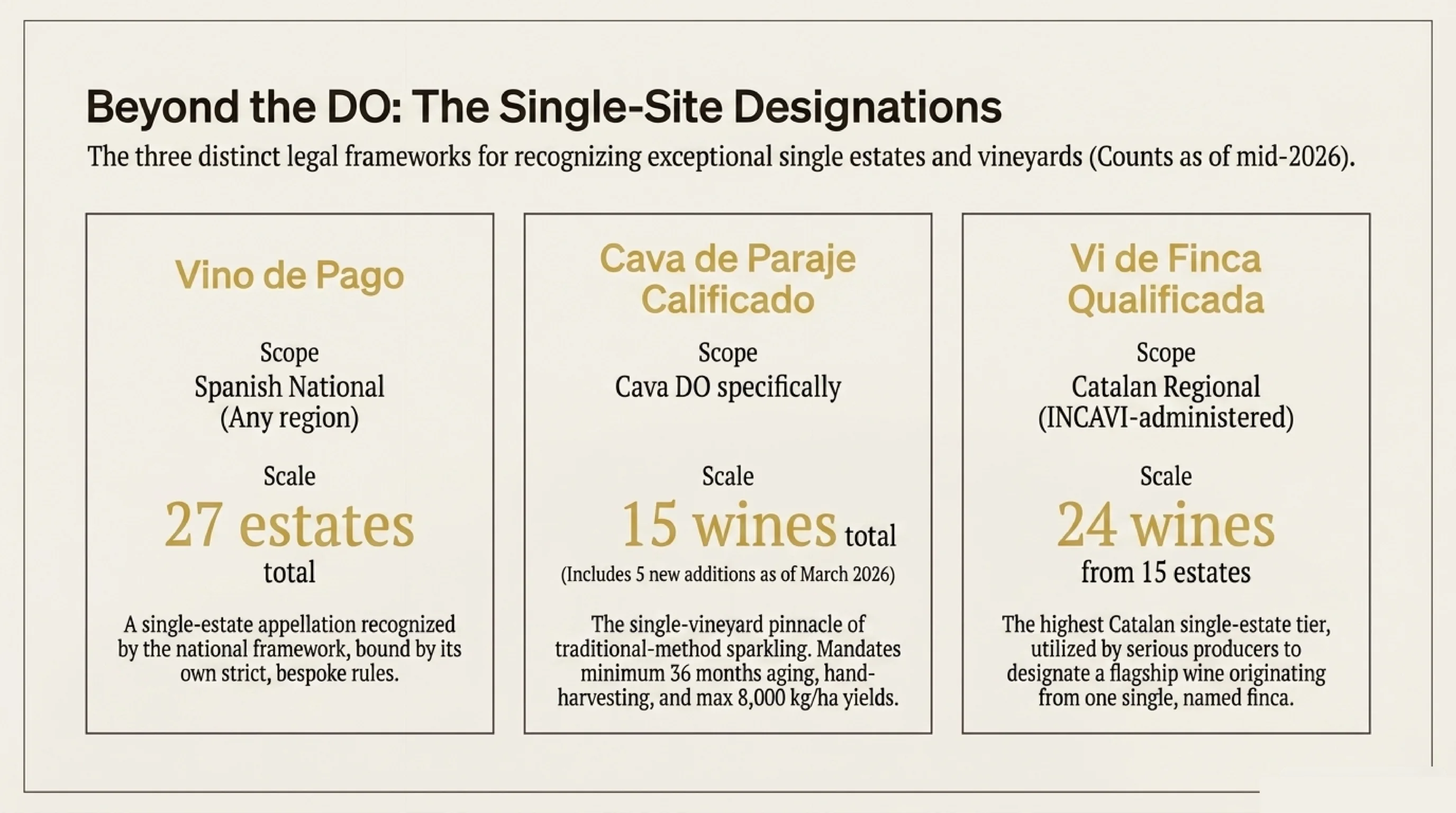
A specifically Catalan-relevant detail of the Spanish wine framework: there are three legally distinct single-vineyard or single-estate categories above ordinary DO level, and Catalonia uses all three.
| Category | Scope | Count (mid-2026) | What it means |
|---|---|---|---|
| Vino de Pago | Spanish national (any region) | 27 estates | Single-estate appellation, recognised by the national framework, with its own strict rules. Catalonia hosts a small share of these |
| Cava de Paraje Calificado | Cava DO–specific | 15 wines (5 new in March 2026) | Single-vineyard top tier within Cava — minimum 36 months on lees, hand-harvest, max 8,000 kg/ha, 100% organic from 2025 harvest, vintage-dated. Created in 2017 |
| Vi de Finca Qualificada | Catalan regional | 24 wines from 15 estates (across Penedès, Priorat, Pla de Bages, Montsant, Terra Alta, Empordà) | The INCAVI-administered Catalan single-estate tier; used by serious Catalan estates whose flagship comes from one single, named finca |
The three are not synonyms — they each have their own legal scaffolding, their own application process, and their own bottle-label markers. A Catalan winemaker producing a flagship Vi de Finca Qualificada at one estate may also produce a Cava de Paraje Calificado from a single vineyard on another estate; both designations can coexist within one producer’s portfolio.
The Catalan DOs and DOQ: All of Them
Catalonia has eleven regional DOs and DOQ, plus the supra-regional Cava DO whose production is overwhelmingly in Catalonia. Here is the complete list:
| Appellation | Created | Comarca / area | What it’s known for |
|---|---|---|---|
| Penedès DO | 1932 statute; Regulatory Council 1960 | Alt Penedès, Baix Penedès, Garraf, parts of Anoia | Whites for Cava (Xarel·lo, Macabeo, Parellada); growing still-red production; centre of Catalan wine industry |
| Priorat DOQ | DO 1954; DOQ 2000 (Catalan); national 2009 | Priorat (Tarragona province) | Concentrated reds (Garnatxa Negra, Carinyena) on licorella slate soil; top-tier Catalan wine |
| Tarragona DO | 1932 statute / officially 1945 | Tarragona province | The oldest Catalan DO; historic region; whites, reds, and traditionally fortified-style wines |
| Montsant DO | 2001 | Tarragona province (rings Priorat) | “Doughnut” around Priorat; Garnatxa/Carinyena; great-value alternative to Priorat |
| Alella DO | 1953 | Maresme (close to Barcelona) | One of the smallest Catalan DOs; Pansa Blanca (a local Xarel·lo synonym) whites |
| Empordà DO | 1972 | Alt Empordà, Baix Empordà (Costa Brava) | Northern Catalonia near the French border; whites, rosés, and reds |
| Pla de Bages DO | 1995 | Bages (central Catalonia) | Small DO; Picapoll (a local indigenous grape) is the signature |
| Costers del Segre DO | 1986 | Around Lleida and the Segre river | Diverse subzones; varietal labelling common |
| Conca de Barberà DO | 1989 | Conca de Barberà comarca | Cava production and Trepat — the rosé-Cava red grape — has its heartland here |
| Terra Alta DO | 1982 | Terra Alta comarca, southern Catalonia — between the Ebro and the Aragonese border | Garnatxa Blanca (white Grenache) country: around 33% of the world’s white Garnatxa grows here, roughly 75% of Spain’s and 90% of Catalonia’s |
| Catalunya DO | 1999 | Catalonia-wide | Regional DO covering wines that don’t fit the smaller, more specific DOs |
| Cava DO (supra-regional) | 1986 | ≈95% Catalonia (esp. Sant Sadurní d’Anoia); zones also in Rioja, Aragón, Valencia, Extremadura | The traditional-method sparkling-wine appellation |
The Catalan system is unusual within Spain in two ways: the density of small regional DOs, and the existence of a single all-region DO (Catalunya DO, 1999) that catches wines made across DO boundaries.
Cava DO: The Special Case
Cava DO is not a regional appellation in the usual sense. It was created in 1986 by Spanish royal decree (Order of 27 February 1986) to protect the traditional-method sparkling-wine category, and the production zone is non-contiguous — small designated areas across multiple Spanish regions. About 95% of production sits in Catalonia (centred on Sant Sadurní d’Anoia in the Penedès), but Cava can also legally be produced in designated zones of Rioja, Aragón, Valencia (Requena), Extremadura (Almendralejo), and a few smaller areas.
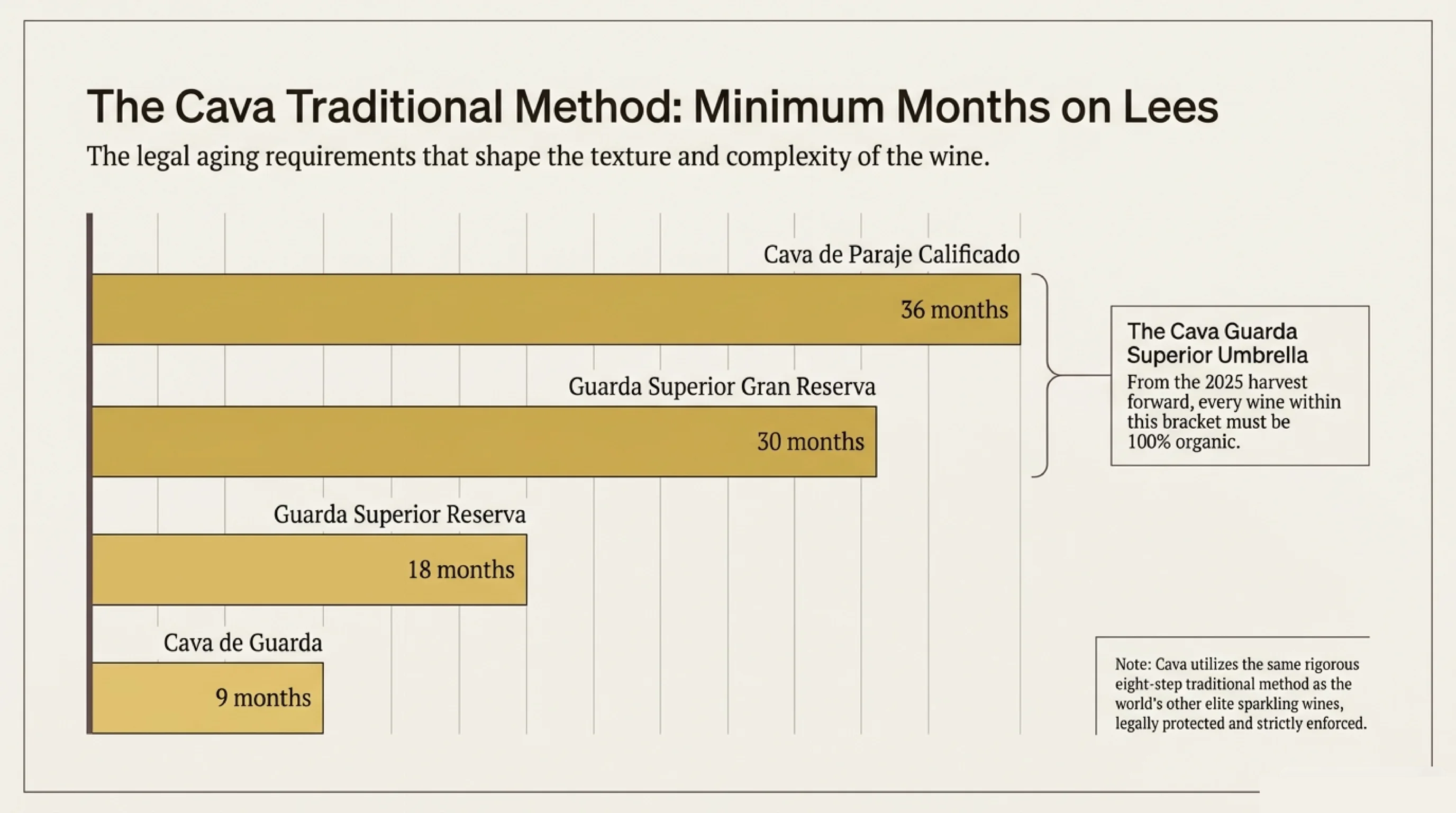
Inside Cava DO there is a quality pyramid that mirrors the broader Spanish aging system but with sparkling-wine-specific rules. The 2025 milestone is the formal Cava Guarda Superior umbrella category, sitting above the entry “Cava de Guarda” — Reserva, Gran Reserva, and Paraje Calificado tiers are all within Guarda Superior, and from the 2025 harvest forward Guarda Superior wines must all be 100% organic.
| Cava tier | Umbrella | Minimum aging on lees | What it signals |
|---|---|---|---|
| Cava de Guarda | (entry) | 9 months | Entry tier |
| Cava Guarda Superior Reserva | Guarda Superior | 18 months (raised from 15 in the 2021 reform, in force 1 Jan 2022) | Premium NV, 100% organic from 2025 |
| Cava Guarda Superior Gran Reserva | Guarda Superior | 30 months | Premium, vintage-dated, 100% organic from 2025 |
| Cava de Paraje Calificado | Guarda Superior | 36 months | Top tier (created 2017) — single-vineyard, vintage-dated, hand-harvest, max 8,000 kg/ha yield, 100% organic from 2025 harvest forward |
As of mid-2026 there are exactly 15 Cava de Paraje Calificado wines holding the distinction, following five new additions in March 2026. These are Spain’s answer to vintage Champagne, and they are made the same way: méthode traditionnelle, the same eight-step process, the same legal protection.
What “DOQ” Actually Asks Producers to Do
The promotion from DO to DOQ is genuinely demanding, which is why only two Spanish regions hold it. To qualify:
- The DO has to have at least 10 years of recognised DO status before applying for the top tier
- All wine has to be bottled at origin — the wine cannot leave the region for bulk bottling elsewhere
- Yield caps are stricter than the parent DO
- Aging rules are more rigorous
- A regulatory council with stricter oversight is in place
- The wines have to demonstrate consistent quality at the highest national tier
Priorat’s promotion in 2000 was the headline event in modern Spanish wine — it formalised what the 1980s and 90s revival of the region had already proven on the bottle. The official wine-bottle label changes too: a Priorat wine carries the DOQ seal in Catalan; the equivalent Castilian DOCa seal appears on Rioja.
Aging Tiers: Joven / Crianza / Reserva / Gran Reserva
Outside of Cava, Catalan still wines use the Spain-wide aging tier system. The labels mean specific time spent in barrel and bottle before release:
| Tier | Minimum aging (red wine) | Minimum aging (white/rosé) |
|---|---|---|
| Joven | No aging requirement | No aging requirement |
| Roble | Brief oak contact (not legally codified universally) | Brief oak contact |
| Crianza | 24 months total / minimum 6 months in oak | 18 months total / 6 months in oak |
| Reserva | 36 months total / minimum 12 months in oak | 24 months total / 6 months in oak |
| Gran Reserva | 60 months total / minimum 18 months in oak | 48 months total / 6 months in oak |
A Priorat DOQ Gran Reserva has therefore spent at least five years between barrel and bottle before release — a serious time commitment for a winemaker, and a marker of the kind of wine the region produces.
The Catalan Linguistic Layer
A practical note for anyone visiting cellars: Catalan and Castilian (Spanish) are both official languages of Catalonia, and you will see both on bottles and tour scripts. Common terms you will encounter:
| Castilian | Catalan | Meaning |
|---|---|---|
| Bodega | Celler | Winery / cellar |
| Viñedo | Vinya | Vineyard |
| Vendimia | Verema | Grape harvest |
| Garnacha | Garnatxa | The Garnacha grape |
| Cariñena | Carinyena | The Carignan grape |
| Macabeo | Macabeu | The Macabeo grape |
| Vino | Vi | Wine |
| Cava (same) | Cava | Cava |
The grape names are not regional variants in a trivial sense — Garnatxa Negra and Garnacha Tinta refer to the same variety, but the Catalan name reflects centuries of Catalan winemaking tradition. The bottle labels usually carry both.
Where the Featured Tour Sits in This System
The featured Penedès 4WD vineyards tour from Barcelona visits two family wineries in the Penedès DO — Pere Ventura Cava in Sant Sadurní d’Anoia, and Can Bas in Subirats. The tastings on the tour cover three still wines from the Penedès DO and four Cavas from the Cava DO; both of those appellations are explained on the visit.
For a tour focused on Priorat DOQ, you need a separate full-day trip. For a tour focused on Cava DO specifically, the big-name house tours (Codorníu, Freixenet) in Sant Sadurní offer cellar-only visits at €20–€30, but they trade depth for scale — a small-group 4WD tour gets you onto the vineyard tracks and into the family-cellar conversation in a way the big-house bus tours cannot.
Common Misconceptions
- “DOQ is just a fancier name for DO.” It is the highest legal tier in Spanish wine, granted to only two regions in Spain to date. It carries real production constraints (bottling-at-origin, stricter yields, mandatory oversight).
- “All Cava comes from Penedès.” Around 95% does, but Cava DO legally includes zones in several Spanish regions outside Catalonia. The geographic protection is for the method-and-area combination, not just Catalonia.
- “Catalunya DO is just a marketing label.” It is a real protected appellation since 1999, used for wines that cross the smaller Catalan DO boundaries — useful for producers who source across regions but want to keep wines within the Catalan protected framework.
- “Crianza is always lower quality than Reserva.” Aging tier is style, not necessarily quality. A skilled producer can make a stunning Joven; an indifferent producer can make a flabby Gran Reserva.
Ready to Book?
There is no faster way to read a Catalan wine label than to stand in front of one with the winemaker pouring the bottle. The featured Penedès 4WD vineyards tour from Barcelona is built around exactly that learning: two family wineries in the Penedès DO, three still wines plus four Cavas, the architecture and the vineyards of one of the great traditional-method regions, $144 with free cancellation up to 24 hours. See also our Penedès vs Priorat day-trip guide and the Cava vs Champagne buyer’s guide.
Penedès Vineyards Tour from Barcelona — Wine, Cava & 4WD
Join 847+ guests who rated this experience 4.84/5. Pickup in central Barcelona, 4WD through Catalan DO vineyards, two family wineries, seven wines and Cavas, a 10th-century chapel, and local cheese and charcuterie. Free cancellation up to 24 hours.
Check Availability & Book