Barcelona Winery Tour: What to Expect
First-timer's guide to a Penedès winery day from Barcelona — itinerary structure, dress code, tasting protocol, food, tipping, and how the reseller model works.
A Penedès winery day from Barcelona is one of the most rewarding day trips in Catalonia — and one where small assumptions can throw off the whole experience. This guide covers what an actual booked day looks like, what to wear, what to expect at each cellar, how Cava tasting protocol works, who is licensing what, and the practical bits (tipping, payment, harvest timing). It is built around the featured Penedès 4WD vineyards tour but most of it applies to any Penedès winery day from Barcelona.
The Shape of the Day
A typical Penedès day from Barcelona unfolds in roughly the same shape, whether you book the featured tour or a similar small-group experience.
| Time | What’s happening |
|---|---|
| 08:30–09:30 | Central-Barcelona pickup at a fixed meeting point — usually near the university (UPC) area or a major plaça |
| 09:30–10:30 | Drive south-west on the AP-7; about 45 minutes to the Penedès |
| 10:30–12:30 | First winery: cellar walk, vineyard or 4WD ride, tasting of 3 wines paired with local cheese |
| 12:30–13:00 | Short transfer between wineries (10–15 minutes typical) |
| 13:00–15:00 | Second winery: cellar visit, Cava tasting of 4 bottles, charcuterie, often the longer tasting of the two |
| 15:00–16:00 | Return drive to Barcelona |
| 16:00–17:00 | Drop-off at the original pickup point |
The featured 4WD Penedès tour runs about 6 hours of tour time (per the operator’s stated duration), with the door-to-door experience naturally longer once you count central-Barcelona pickup and drop-off. It visits two wineries — Pere Ventura Cava in Sant Sadurní d’Anoia and Can Bas Domini Vinícola in Subirats — both family-managed enough that the cellar-master or family member typically leads at least part of the tasting. A practical detail worth knowing: Pere Ventura S.A. acquired the Can Bas estate in 2011, so the two cellars are part of the same Pere Ventura Family Wine Estates group (alongside their Priorat estate Merum Priorati). The 4x4 vineyard ride happens on the Can Bas estate property — a 250-acre estate in Subirats whose history reaches back centuries (a 900 AD Sant Joan Salerm church sits on the property, the “10th-century estate chapel” of the tour itinerary).
This is not a coach tour. The transport is a minibus from Barcelona, and the 4WD ride is at the vineyard itself — onto farm tracks no minibus can reach, through the vines, the limestone soil under your wheels.
What Actually Happens at Each Winery
Each cellar visit follows a similar three-part shape:
- The cellar walk — usually 30-45 minutes. The guide or family member walks you through the press, the fermentation tanks, the oak cellar (for still wine), and the underground Cava cellar (for sparkling). You see the bottles laid horizontally on the lees, the riddling racks, and the dégorgement station. This is where the méthode traditionnelle — second fermentation in the bottle, the eight-step process — becomes physical
- The vineyard or 4WD ride — varies by winery; the featured tour includes a 4x4 ride through historic vineyards with a local viticulturist, including a stop at a 10th-century estate chapel
- The seated tasting — 30-60 minutes. Bottles are opened, glasses lined up, food brought out, and the cellar-master or guide walks you through each pour: the grape, the aging, the dosage tier, what to look for in the glass
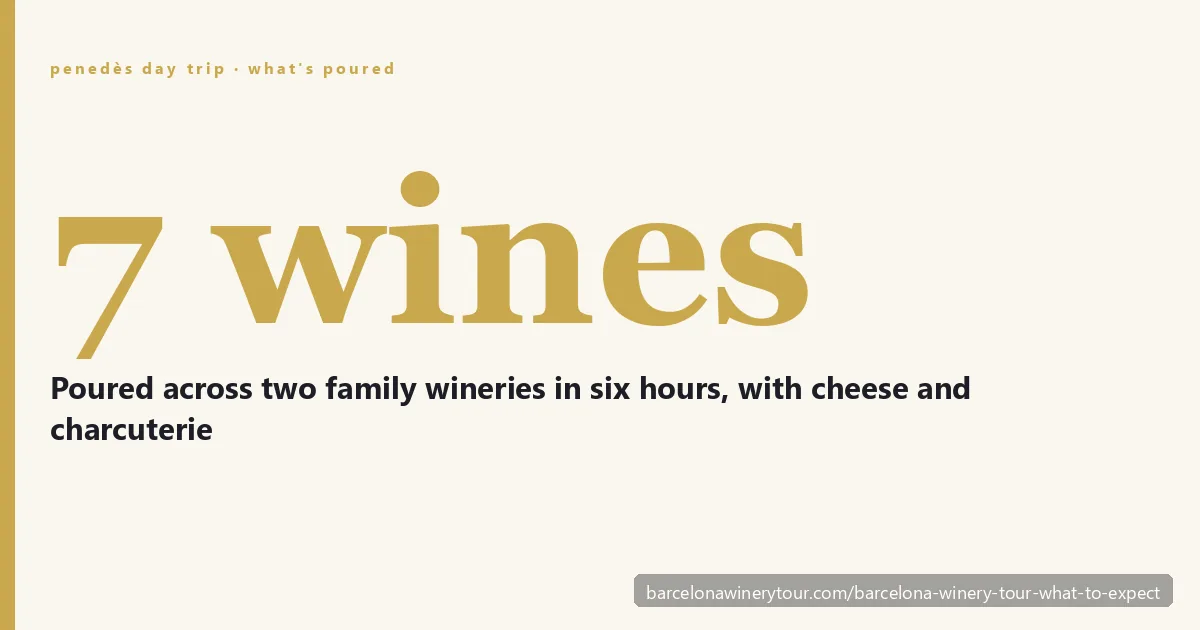
The featured tour pours 3 still wines + 4 Cavas across the two wineries — seven wines total — paired with local Catalan cheese and charcuterie. The cheese is usually a mix of cured sheep and goat cheeses; charcuterie typically includes Iberian-style cured meats, often with bread and olives. This is genuine food, not a token cracker.
What Cava You’ll Actually Taste
A typical Cava flight at a family producer covers three or four bottles representing different sweetness tiers and grape compositions:
| What you’ll likely taste | Style | What to notice |
|---|---|---|
| Brut Nature | <3 g/L residual sugar; bone dry | Pure expression of the grape and the lees; sharpest end of the spectrum |
| Brut | <12 g/L; slightly fuller | The default style; what most “Cava” you’ve had before is |
| Rosé Brut | Made with Trepat, Garnatxa, or Pinot Noir | Pink colour from skin contact; same dryness; different aromatic profile |
| Reserva or Gran Reserva | 18+ months on lees (Reserva) or 30 (Gran Reserva) | Toasty, brioche, almond notes — the signature of long lees contact |
| Vintage / Cava de Paraje Calificado | Single-vineyard, vintage-dated, 36+ months on lees | The top tier — there are only 15 in the entire world as of mid-2026 |
The sweetness scale on Cava labels follows the EU dosage tiers shared with Champagne: Brut Nature → Extra Brut → Brut → Extra Seco → Seco → Semi-Seco → Dulce, dry to sweet, with Brut as the default. “Extra Seco” is sweeter than “Brut” — a recurring source of confusion. The cellar staff will explain which tier each bottle is.
Dress Code and What to Bring
The featured tour is “smart-casual outdoors.” Specifically:
- Comfortable closed-toe shoes with grip — cellar floors are damp limestone and can be slippery; the 4WD ride and vineyard walks need real shoes
- A light layer — cellars run cool (around 14-16 °C year-round in Penedès, slightly warmer than Champagne’s 10-12 °C chalk cellars); spring and autumn especially you’ll want a sweater
- Sun protection — vineyard walks in summer (the operator’s “to bring” list specifies sunglasses and a sun hat); the Mediterranean light is real
- Passport or ID card — the operator requires this for the booking
- No heavy perfume or aftershave — masks the wine aromas for everyone in the room; this is real winery etiquette, not a suggestion
The featured tour has a minimum age of 16 years old. It is not wheelchair-accessible (the 4WD section and the cellar layouts can’t accommodate). Pets and luggage are not permitted in the vehicle.
Tipping, Payment, and Cellar-Door Logistics
A few practical points that are easy to get wrong:
- Tipping is not customary in Catalonia. Rounding up a small bill is standard; for an exceptional driver-guide or cellar host, 5-10% is a generous tip. 15% would be unusual and not expected. The featured tour explicitly lists “Tips (optional)” in its excludes — not required
- Cellar-door purchases. Both wineries on the featured tour sell direct, and the 4WD has space for crates. Cards are widely accepted, but small family wineries sometimes prefer cash for small purchases — bring some Euros if you plan to buy
- International shipping is sometimes available; ask the cellar staff on the day. EU residents can carry wine freely; non-EU travellers should check the customs rules of their home country before stocking up
- Drink-driving. Spain in 2026 enforces a 0.2 g/L blood-alcohol limit (0.1 mg/L breath) for all drivers under a unified safety law. This is one of the strictest in Europe. If you were considering self-driving the Penedès, joining a guided tour with included transport is the practical choice
Who Owns What: The Operator and the Winery
Worth knowing for any GetYourGuide-style booking: the featured tour is run by World Experience (legal name WE THE CLUB SL), a Barcelona-based wine-and-experiential tour operator. GetYourGuide classifies them as the direct Activity Provider for this tour (product ID 94605) — they own the booking, they run the minibus and the driver-guide, and they coordinate the day. The two wineries the tour visits are Pere Ventura S.A. and its Can Bas estate, both family-owned and part of the Pere Ventura Family Wine Estates group since the 2011 acquisition of Can Bas.
What this means in practice:
- The booking is one ticket — World Experience handles the central-Barcelona pickup, the minibus to the Penedès, the driver-guide, and the day’s logistics
- The cellar visits, the tasting pours, and the cheese-and-charcuterie are produced by Pere Ventura’s actual cellar staff at their actual cellars — not by the tour operator
- Pere Ventura is a substantial premium producer (around 2.5 million bottles a year as a group; 100% organic Cava Guarda Superior focus), with their Gran Vintage holding Cava de Paraje Calificado designation — one of only 15 wines in the world to do so as of mid-2026
- The 4x4 vineyard ride happens on Can Bas’s own 250-acre estate; the 10th-century chapel on the itinerary is the Sant Joan Salerm church on the same estate
This is the classic “operator brings the guests, winery pours the wine” model, with the additional detail that the two wineries on this tour are under common ownership — which means the day is curated by the Pere Ventura group to showcase both the Cava cellar (in Sant Sadurní) and the still-wine + estate-history side (at Can Bas in Subirats).
Best Time of Year to Go
Each season has a different feel:
| Season | What it’s like |
|---|---|
| Spring (April-June) | Wildflowers between the vines; mild weather; cellars busy but not packed; one of the best windows |
| Summer (July-August) | Hot, vines dense and green; bring sun protection; can be sweltering on vineyard walks |
| Harvest (mid-August through October) | The most atmospheric — verema / vendimia underway; you can sometimes see grapes being picked. White Cava grapes (Xarel·lo, Macabeo, Parellada) harvest mid-August through early October; red Garnatxa typically follows late September through October |
| Autumn (October-November) | Dramatic vineyard colours; harvest just finished; cellars often at their busiest with the new vintage |
| Winter (December-February) | Quieter; vines pruned and bare; cellars warm and full of ageing bottles; good for serious tasting without crowds |
If you can pick, late April through early June and mid-September through October are the two sweet windows — temperatures are pleasant, the vineyards look alive, and the cellars are busy enough to feel atmospheric but not packed.
A note on local festivals: Sant Sadurní d’Anoia hosts the Festa de la Fil·loxera in early September (commemorating the phylloxera epidemic that reshaped the region’s viticulture in the 19th century) — a wine-and-cellar-focused civic event well worth aligning a visit around. The town’s official Festa Major falls at the end of November.
Common Mistakes Worth Avoiding
- Booking on a Sunday afternoon expecting a long lunch. Many small Penedès wineries close mid-afternoon Sunday; tours on Sundays typically end earlier than weekday equivalents
- Eating a heavy lunch before pickup. The cheese and charcuterie at the wineries is real food, and Cava plus food is the whole point — arrive hungry
- Expecting hotel pickup. The featured tour and most Penedès operators use a fixed central-Barcelona meeting point — make sure you know which one
- Treating it as a generic “wine tour.” Cava DO has its own legal framework, its own grape varieties, its own production tradition; the more you know going in (see the Cava vs Champagne guide), the more the day repays you
- Assuming all tours visit Codorníu or Freixenet. The big-name houses run their own cellar tours separately at €20–€30 entry; a small-group operator-led tour like the featured 4WD experience visits family wineries instead — different value proposition
Ready to Book?
The Penedès 4WD vineyards tour from Barcelona is the small-group, family-winery, vineyard-track version of a Penedès day — central-Barcelona pickup, two family wineries (Pere Ventura Cava and Can Bas), three still wines plus four Cavas, a 4WD ride through historic vineyards, a 10th-century estate chapel stop, local Catalan cheese and charcuterie, English- or Spanish-speaking driver-guide. $144 per person, 4.8/5 from 847+ guests, free cancellation up to 24 hours. See also the Penedès vs Priorat day-trip guide and the Catalan DO/DOQ system explained for the broader regional picture.
Penedès Vineyards Tour from Barcelona — Wine, Cava & 4WD
Join 847+ guests who rated this experience 4.84/5. Pickup in central Barcelona, 4WD through Catalan DO vineyards, two family wineries, seven wines and Cavas, a 10th-century chapel, and local cheese and charcuterie. Free cancellation up to 24 hours.
Check Availability & Book